








As part of our Young Critics Collective programme, Leah Hudson and Scarlet Driver review Monster by Naomi Wood.
Part of the Nottingham Poetry Festival, Monster is a true story about feeling exposed in the ocean and learning to love both people and pond life. This is a show about the transformative power of chucking yourself in the deep end.
Young Critics are an imaginative collective of students that value collaboration and innovation. Together, they review and help shape future theatre programming.
Reviews
“As soon as you can see, you realise you can be seen.”
Raw, honest and vulnerable. Naomi Wood’s spoken word show Monster is truly a powerful performance, especially for those who have traversed through life feeling unseen. The magic of Naomi is just how candid and relatable she is; how she speaks to the audience as if they were lifelong friends; how her energy draws you into her story. Naomi delves into the complexity of grief, shame and depression as she tries to navigate her life as someone wanting to fit in, eventually realising that it is easiest to simply be true to herself.
The set itself turned out to be a big part of the message behind the show. The jellyfish made by a fellow artist from fabric and fairy lights, as well as the blue stage lights, create a beautiful under-the-sea atmosphere which highlights how the arts community comes together to help their own. It also signifies how we should not be afraid to face our fears, as Naomi describes how she is scared of the sea and the unknown creatures that lurk within it, yet she surrounds herself with it throughout her show. As Naomi explores her fears and describes how she felt as though she was ‘drowning’, the blue lights become isolated and create a scene from the scary depths of the ocean. The underwater motif continues throughout the show with the angler fish becoming a clever metaphor for those who feel isolated in the scary depths, needing a light to shine the way forward.
Even though the audience was a mix of older generations and young adults, the reactions to Naomi’s hilarious wit and emotional depth were the same. Especially with the story of voice notes, something that everyone uses and can relate to, Naomi had the whole room laughing. And as she delves deeper into the depths of heavier topics such as shame and grief, the audience falls into a heavy silence as they take in every word she says. Within the whole show, there is something that every person in the audience can relate to, whether it be the complexity of grief or the shame that comes along with suppressing desires; Naomi makes you feel less alone in your experience.
As the performing arts studio in Lakeside Arts is smaller than the usual stage room, the show feels much more intimate and allows for the audience to feel a part of the show. Naomi does not shy away from audience participation; giving us breathing exercises to follow along with, as well as clapping along. She even initiates some audience members to move seats to even out each side so that it wouldn’t distract her, which, although a pause in the show, just adds to the honest and true to self feel of the performance.
Naomi’s Monster makes everyone feel seen. With the depression after a break-up, the complex relationship between herself, the church and her father, and the shame of suppressing one’s own desires, Naomi really covers it all in a deep and relatable way. As the performance comes to a close, the powerful message of just being who you are, as there is ‘space in the spotlight for darkness too’ really hits home. Naomi’s brilliant writing leaves the audience with a feeling of being seen, and the comfort of knowing that we are not alone.
Monster by Naomi Wood is a deeply personal piece that blends storytelling with poetry, melting emotional beats, humour, and vulnerability into something that feels both intimate and expansive. But what struck me most is that the experience doesn’t begin with the first line of poetry—it begins the moment you step into the space. The performance invites you into a world before Naomi even appears, asking you to start reading, feeling, and interpreting long before the first poem lands.
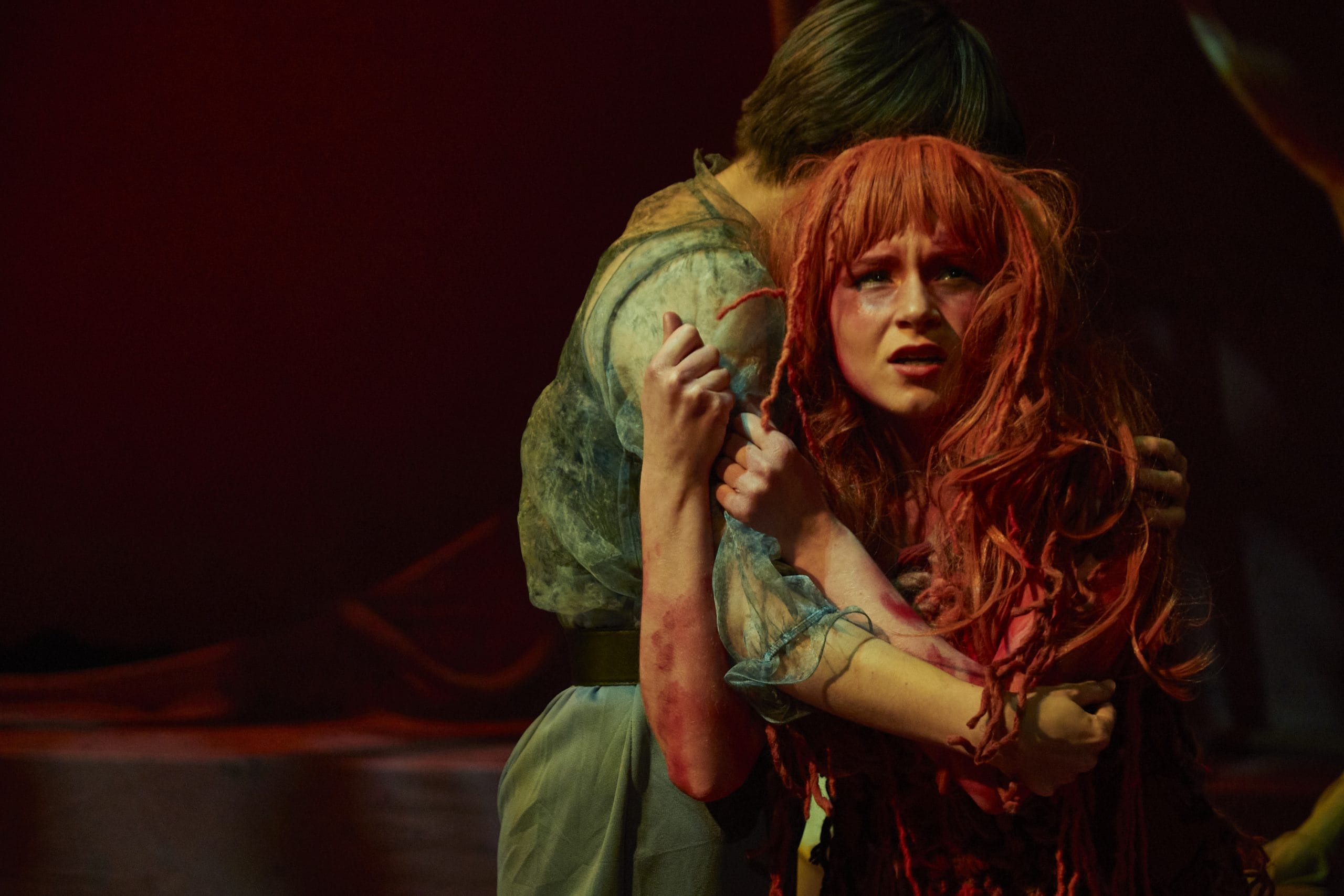
Poetry has a way of opening doors inside you, of letting you discover meaning in the smallest gesture or object, and the set design embraces that instinct completely. The underwater theme is not just aesthetic; it’s atmospheric, symbolic, and quietly suffocating in the way the sea can be. The stage is washed in deep blue light, the background filled with handmade jellyfish and sea‑like materials that sway gently, as if caught in a current. It’s beautiful, yes, but also unsettling—an echo of the poetic narrative’s exploration of being submerged, trapped, or suspended in the unknown.
Then there are the objects that interrupt this aquatic world: a treasure box to the left, and centre stage a table with a cup, saucer, and a stark black wooden cross. These elements immediately disrupt the natural coherence of the sea imagery. They force you to pause, to dissect the contrast, to ask what it means for something so domestic—and something so spiritual—to sit inside a world of water and drifting creatures. It’s a clever visual dichotomy that mirrors the poems themselves: the tension between what grounds us and what overwhelms us.
Costuming, too, plays its part with subtlety. Naomi’s use of small costume motifs is engaging, especially the blanket she wraps around herself. A blanket underwater is a contradiction—it should weigh you down, drag you deeper—but here it becomes a symbol of dysfunctional comfort, the things we cling to even when they hurt us. Later, when she removes a piece of her established costume, the shift is palpable. It feels like a shedding, a freeing of the self from the weight of experience and thought. These choices are small but potent, and they echo the emotional arc of the performance.
The projector adds another fascinating layer. When it flickers to life, it momentarily disconnects us from the underwater world, snapping us out of the dreamlike immersion. Suddenly, Naomi is not a figure drifting through metaphor—she is herself, unfiltered, unmasked. It creates an unexpected dynamic where technology becomes a bridge rather than a barrier. In a cultural moment where the internet is often framed as isolating, Monster offers a refreshing counterpoint: technology as connection, as clarity, as a way of reaching out rather than retreating inward. This idea is cemented beautifully in the poem about voice notes—witty, relatable, and quietly profound in how it celebrates the strange intimacy of sending your voice into someone else’s day.
Audience interaction is another key thread woven through the performance. Naomi invites us into breathing exercises, asks us to raise our hands if we’ve experienced certain things, even passes around a packet of crisps for everyone to share. These moments aren’t gimmicks; they’re gestures of solidarity. Not every audience member will relate to every poem, but everyone relates to being human. These interactions become a symbolic hand extended to the room, saying: You’re not alone in this. The audience’s glowing response—every laugh, every murmur, every held breath—speaks to how deeply this piece resonates.
If there is one note I’d offer, it concerns the music. The compositions themselves are beautiful, and the timing of their entrances often amplifies the emotional landscape of the poems. But at times the volume slightly overpowered Naomi’s voice, and when the words are this carefully crafted, losing even a line feels like losing something precious. A small adjustment would allow the language to shine as brightly as it deserves.
In conclusion, Monster is a performance that understands the human experience in all its tangled, tender complexity. From the immersive set to the thoughtful use of costume, from the interplay of technology to the warmth of audience interaction, every element works in harmony to create a piece that feels both personal and communal. Naomi Wood invites us not just to listen, but to feel, to reflect, to breathe with her. And in doing so, she reminds us that poetry is not just something we hear—it’s something we live alongside.