







As part of our Young Critics Collective, Genevieve Melling and Zoe Lam reviewed Triptych by Lewis Major.
A unique performance from the rising star of Australian dance, choreographer-director Lewis Major, presenting a captivating evening exploring the connection between internal and external worlds.
Young Critics are an imaginative collective of students that value collaboration and innovation. Together, they review and help shape future theatre programming.
Reviews
In Lewis Major’s Triptych, contemporary dance forcefully collides with visual spectacle to create a chaotic, beautiful, and raw work of universal human existence. Structured into three distinct segments, Major has produced something that expands and grows on stage like a living entity. What emerges is an immensely powerful performance that leaves viewers with a profound respect for the dancers’ physical capabilities, as well as a haunting sense of having briefly stepped into an introspective space between worlds, a place from which to contemplate the cyclical, shared experience of existence.
The piece seems to examine both freedom and confinement within repeating cycles of experience. The first segment centres on a solitary female dancer, encased in a sharp spotlight that carves her out of darkness. Her arms unfurl with balletic precision, blending highly charged, intentional gestures that shift from jagged sharpness to soft, fluid lines, illuminated in sharp focus as she attempts to break from this restricted, delineated space. The repetitive movements in this scene built progressively in tempo and range, creating a hypnotic trance that was nearly impossible to break focus from. In fact, the work successfully retained my attention till the very end.
The use of lighting was ingenious, dominating the mise-en-scène throughout, helping to elevate the themes and create a visually stunning show. One particularly captivating moment was when a performer appeared trapped within a revolving light beam; an optical illusion that made it nearly impossible to discern how she moved in perfect synchrony with the turning line of light.
Relationships, with their interconnectivity and dependence, emerge as equally powerful motifs. Through varying pairings, male duets, female duets, mixed couples, and solos, the dancers explore human relationships via raw physical dialogue, impressive lifts, and intricate intertwining of bodies. In one striking sequence, two female dancers are bathed in red light, which makes them appear stripped of their flesh. They lie intertwined, their bodies almost merging into a shared form. The all-male duet is particularly worth noting for its breathtaking strength and intimacy as the performers lift and support one another with complete trust and dependency.
The performance is also a visceral ode to the human body’s extraordinary capabilities. The four insanely talented dancers are dressed in minimalistic costumes that ensure focus remains on the human form. Every ligament and muscle is defined in minutiae under the strong lighting, showing the sheer strength and capacity for movement of these dancers. This amplifies a powerful sense of universality: the raw, shared experience of being human in all its fragility and resilience.
Lewis Major’s Triptych envelops viewers in a swirling, overwhelming, glorious dance that lingers long after the lights dim, reminding us of our collective entrapment in and transcendence through our existence.
A siren rings out once, its round sound fading out into darkness. A single dancer is framed in a box of light, her hand reaching slowly upwards, her joints hinging with an anatomical precision. Another siren ring guides her movement, accelerating slightly then becoming static again. The square spotlight around her is hollow, darker at its centre so that as her arms extend outward, they catch the brightness. Although in and out of this light’s shadow, she is firmly present.
Lewis Major’s Triptych, near the start of its tour, is shaped by his choreographic vision prioritising local communities alongside a global outlook. Major’s intrigue with form and light, the organic and the mechanical, is present from the first dancer’s pose. Other dancers take her place, with slow steady movements that become increasingly dynamic. The warm light shifts across the stage forming an intimate connection with the audience. Two dancers appear, one standing on the other. She never touches the floor; they’re entirely united, lifted and intertwined. Their limbs tangle in trust and separate only to extend their sculpture out to the boundaries of the spotlight. The once built-up energy stored in slow fluidity is finally discharged through whirling. Whirling limbs, souls, pointed toes, arched backs…
The heart of Triptych presents a more literal psychosomatic piece, contrasting the organic and rigid. The four dancers stand centre stage in rays of dappled light, with ripples of water projected at their feet. This quickly shifts from something archaeological to architectural, as a white laser beam sweeps over them like a 3D printer. It traces and maps their bodies as a united and tangible form yet is rendered somehow abstract. Another beam comes, and more lasers sporadically sweep the stage. They move like radio waves with energy and flow, set against fast paced movement and lightly pounding electronic sound.
As the music slows, the stage leaves two moving beams of light, ridden by two dancers. They move in symmetry, as if they were static and only the beams spinning. Eventually, they walk slowly towards each other with outstretched fingers. Carefully they lie together under the now scattered light, as if they’re being covered by the Earth or even becoming part of it. This clears, residing to a ring around them and they lie quietly in the red glow left behind. Something cyclical, something scientific, and something ceremonial has occurred.
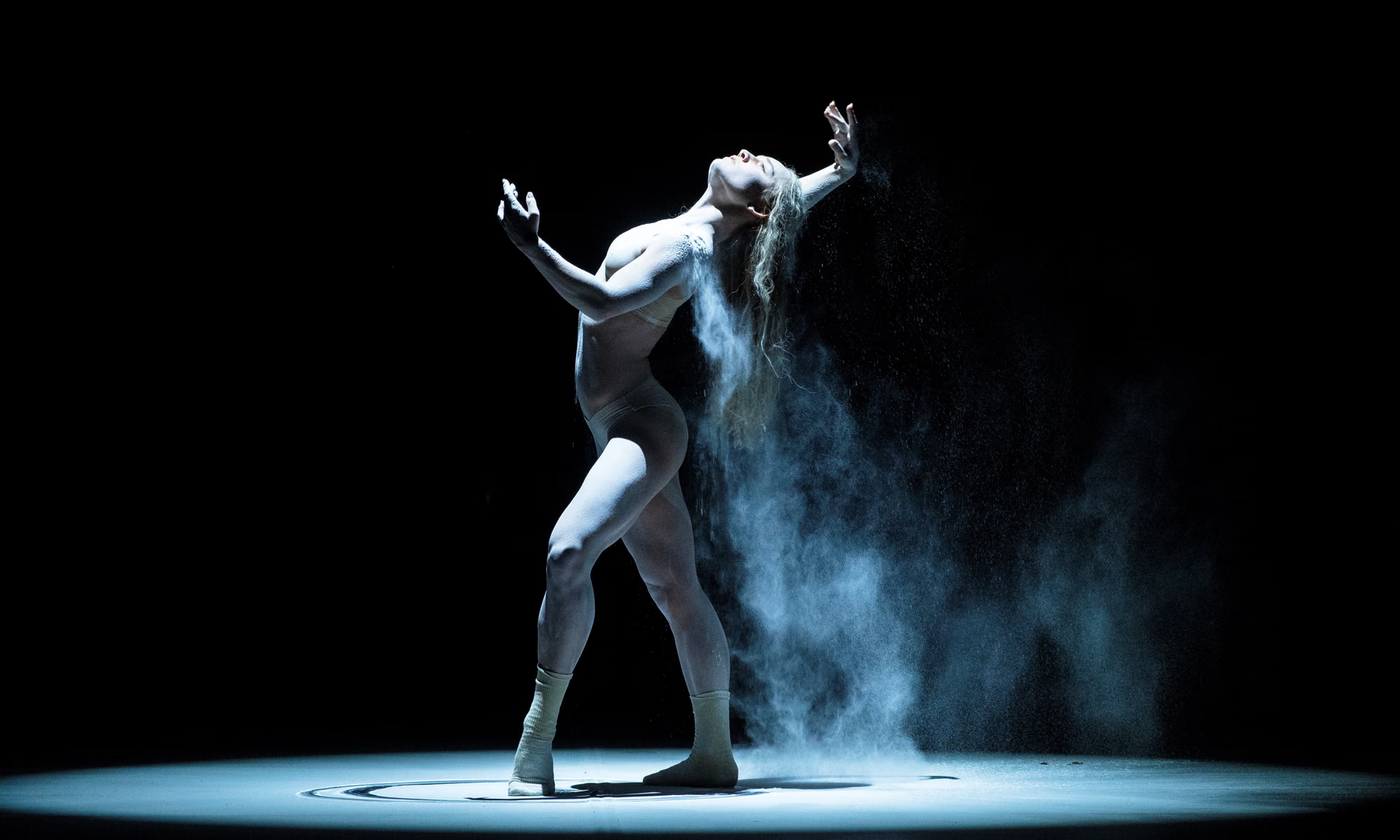
The closing piece to Triptych arrives behind black cloth, shielded from audience eyes. Once revealed, a dancer is holding a statue posture of power and tranquillity, covered and standing in white dust. Again, she starts moving slowly, as Debussy’s Clair de Lune guides her movements through chords and octave jumps. The electronic filter of the piano keys references the earlier dichotomy of organic and rigid, but we are too mesmerised by her movement to get caught up in the sound. Her direction ebbs and flows following the weight of her body with total commitment, completely honest with gravity. When she lifts her arms and tilts her head the dust falls in clouds around her. Her pointed feet drag through the white, tracing her movement. Every path and circle is inscribed, and then slowly fades as she moves on, constantly redistributing the evidence of herself. What she leaves is a palimpsest of movement, a monument to her ephemeral and persistent presence. She is, without any external dialogue, describing something we recognise entirely.
The dancers return together and take their bow standing in the accumulated dust, our impressionists of the evening. When they leave the stage, their footprints stay behind. The specific weight of their bodies, the angles of their turns, all holding their presence. And after the lights go down the audience hold onto the silence. We are left to wonder: How do we hold each other through boundaries of light? What does it look like when our bodies tell contrasting truths? What does it sound like when our dusty footprints are blown away?