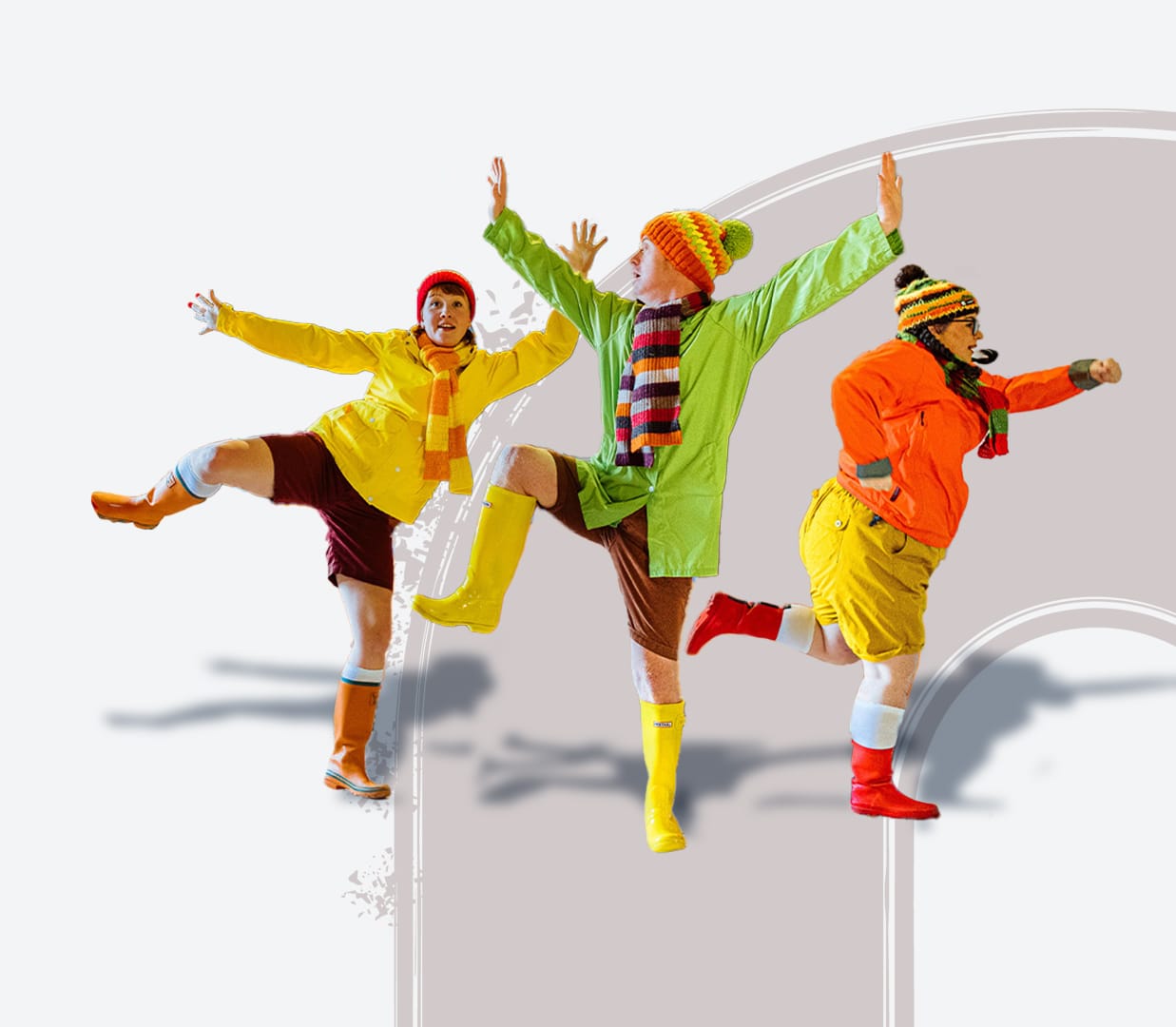




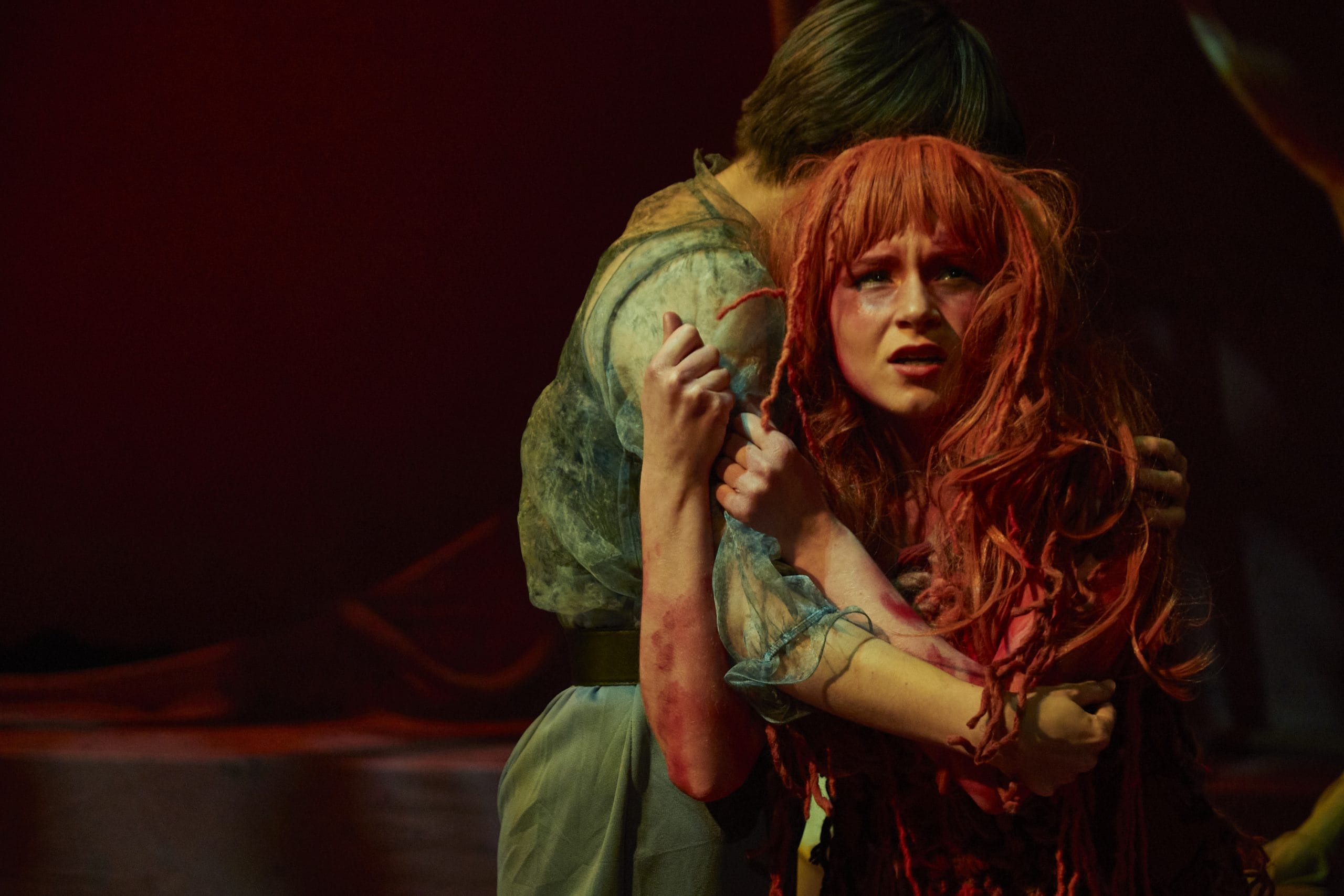





As part of our Young Critics Collective programme, a selection of students review Rapunzel by Wrongsemble.
Rapunzel is a bold, funny, prince-free adaptation of the book by Bethan Woollvin packed with lively music, magic, and madcap schemes!
Young Critics are an imaginative collective of students who value collaboration and innovation. Together, they review and help shape future theatre programming.
Rapunzel Reviews
Witch, Please!
Wrongsemble’s delightfully ‘Prince-less’ adaptation of Bethan Woollvin’s children’s book ‘Rapunzel’ won over the audience on Sunday morning at Lakeside Arts. Prior to the show, the building buzzed with excitement as parents rushed to grab their last-minute coffees, and the audience hurried in for shelter on Nottingham’s first truly chilly October day.
Thankfully, the crowd certainly seemed warmed by the Elvi Piper-directed two-woman show, starring Krushnaa Chousalkar as the endearingly cheeky Rapunzel, and Hope Yolanda as the conniving Witch holding her hostage. The opening of the play introduces the key refrain ‘Oh No Not She’, an incredibly catchy ditty establishing the theme that this Rapunzel is unlike many princess stories children are familiar with – Sleeping Beauty, Cinderella and The Little Mermaid, for example – that rely on a male saviour for the ‘damsel in distress’. In this production, Rapunzel escapes the tower without any outside help, as well as defeating the Witch.
The excellent songs, courtesy of Claire O’Connor and Bay Bryan, move effortlessly between genres, drifting from rock to hip hop as easily as Hope Yolanda’s Witch slides into Aretha Franklin-esque vocal runs while maintaining her menacing demeanour. Chousalkar’s Rapunzel is the perfect foil, matching the Witch’s villainy with brighter, more uplifting singing voice, as well as some well-timed eye-rolls behind the Witch’s back. The musical highlight, however, was the interactive dance during country song “Woodland Hoedown”, which had every child (and some parents) on their feet. This song also acted as an excellent icebreaker as from that point on, almost every line in the second half of the play was met with laughter. The parents in the room also enjoyed an array of clever references, including (but not limited to!) MC Hammer’s 1990s classic ‘U Can’t Touch This’, Hamlet and Nietzsche.
The simple set consisted only of a few trees, a yellow gate and, most impressively of all, a very long rolled-up tapestry, that slowly unravelled throughout the play to reveal relevant information for the scene, and even become a part of the scenery, such as being a window Rapunzel looks through. The foam trees, reminiscent of British playgrounds, suit a show made for children, echoing the round shapes and bold colours of Woollvin’s original illustrations.
The most original twist of this tale is that Rapunzel finds a new career at the end of the play as a bandit, travelling the land and rounding up evil witches in revenge for her life in captivity. This unconventional ending reinforces that Rapunzel is not a damsel waiting to be rescued, but rather the heroine of her own story. The play takes a little while to find its feet, and some adult references will go over the children’s heads, but once “Woodland Hoedown” gets the crowd moving, Wrongsemble’s Rapunzel is a joyful and hilarious retelling that children and parents will enjoy equally.
Wrongsemble, a Yorkshire-based company making family theatre for everyone, with accessibility and shared experience at its heart, makes a stop at Lakeside Arts in Nottingham. Rapunzel, written and directed by Elvi Piper, stretches from Norwich in September to a Christmas run in London. This faithful but irreverent musical adaptation of Bethan Woollvin’s picture book is performed by just two actors, Krushnaa Chousalkar and Hope Yolanda, who switch seamlessly between roles. With inventive staging and a fearless, independent heroine, it shows that Rapunzel needs no prince to save the day.
The show wastes no time, opening with a catchy song, “Oh No Not She”, from the Jailbirds, followed by narration from Fairy-jail, which hooks the young audience and tosses them straight into the action. The tune returns as an instrumental reprise each time the story goes back to Fairy-jail, and the finale reuses it, so children quickly learn to recognise it as a signal of where they are. Dim blue lighting marks Fairy-jail as an ominous place and lifts the audience out of the present story to the narrators. One Jailbird lingers in the scene, resets the set and narrates, an omniscient storyteller who both tells and builds the story, letting the audience see how it is made as it unfolds.
Rapunzel, played by Krushnaa Chousalkar, is full of energy and child-like curiosity, which makes her instantly likeable, but she is also fearless and strategic. She repeatedly breaks the fourth wall to explain her detailed escape plan to the audience, pulling the children into the action. The contrast comes from Prince Phopp, a clever foil created by a quick costume change from the same performer. Searching for a damsel and danger, he asks the audience for a snack or water, and when the children shout “no”, he whines. Then, ironically, he spots the tower and decides to nap. While he sleeps, Rapunzel escapes unaided, her independence made funnier by his indifference. Her aside that there is “not a prince in sight, well not one of any use” feels apt, and it tells young audiences they can be fearless and independent too.
Hope Yolanda’s villainous Witch is the show’s other comic engine, in a performance that runs on exaggeration. Big gestures, voice effects and distinct gaits separate the characters, and outfit changes are so smooth that two performers feel like a full cast. Yolanda also plays Sheriff the Horse and Steve the pigeon, who is nothing more than a placard yet still earns laughs. The humour works on two levels. Farting and burping sound effects brought huge laughs from the children and gasping laughs from their parents, while the Witch’s self-aware asides, and a “say a little prayer” song were pitched squarely at the adults. A ballet sequence turns the supposedly scary Witch absurd and leaves Rapunzel visibly in control, before the show cuts straight to the hair-cutting.
The minimal set does a great deal. Flat cut-out trees in yellow, white and grey, saloon doors and a fabric tower on a frame all follow the book’s palette, bringing its pages to life on stage. Everything sits on one flat level, so the Witch’s climb up the tower is imagined, the performer simply acting it out and proving the power of gesture. Hats carry much of the characterisation: the Jailbirds’ black and white striped cones, no hat for Rapunzel and a cowboy hat for the prince, while ordinary props stand in for bigger things, such as a teacup or comb for his moustache. Hair is handled with the same ingenuity: yellow fabric becomes Rapunzel’s long locks in a late song, yellow paper shreds are tossed up as the cut hair, and “snip snip” is written on the tapestry. Performers change set, props and costumes on stage rather than off, dressed in dark colours against dark curtains so they move almost unseen and never distract the children. These visible changes, the placards standing in for characters and a Witch who knows she is in a play give the show Brechtian touches, but the effect is complicity, not distance. Children see how the story is made, and just as Rapunzel makes her own escape, they are invited to be part of it.
That invitation becomes literal in the show’s highlight, an upbeat country song led by Sheriff the Horse called “Woodland Hoedown”. Having already seen Rapunzel step off the stage to wave hello, the audience is now called Sheriff’s “woodland friends”, and she teaches simple dance moves one step at a time with the house lights up, a signal that the children are part of the show. When the lights drop and the music starts, Sheriff and Rapunzel sing live over the recorded track and dance in perfect sync, while the children clap along, wait eagerly for their cue and do the dance. A clever addition to the performance, allowing the learning to happen first so even the youngest can succeed at participating. At Lakeside, the room of mostly under-fives filled with a wonderful energy which everyone helped to create.
Ultimately, Rapunzel offers an enduring tale of heroism in an inventive, humorous and empowering production. The staging revives the picture book’s strong and inspiring spirit, and, true to a company that privileges imagination, shows that anyone can build their own escapes. A funny, joyful treat, perfect for families, with the “Woodland Hoedown” still ringing in the ears.
Wrongsemble’s wacky yet delightful production of Rapunzel kept the audience giggling throughout. If you are expecting the Disney film, just about the only connection is the chant ‘Rapunzel, Rapunzel, let down your hair’. The tale is eccentric and absurd, and its departure from any expectations helped the actors (Krushnaa Chousalkar and Hope Yolanda) do this retelling justice. It maintained the feeling of Bethan Woollvin’s picture book through images (presumably taken from the book) to aid the storytelling- even if they ultimately ended up stroon across the floor, along with the remnants of Rapunzel’s hair.
From the offset, the infectious energy of the cast more than made up for the sparse staging and props. In an exercise of imagination and comedy, we are asked to suppose that Chousalkar’s short brown hair is actually meters of golden locks. Far from removing the audience from the story, this allowed for far more comedic moments, like miming a strand of hair getting caught in the throat which quickly became a choking hazard. Likewise, the characters wore basic dresses, especially compared to several young girls in the audience, but this showed simple symbolism- Rapunzel wore white and the witch black. (Both also donned a lovely pair of cowboy boots, which I was very jealous of).
The actors clearly have an intuitive understanding of children’s humour, and almost nothing was taken seriously for the entire 45 minutes. Though clearly rehearsed meticulously, they allowed enough space for laughter and interaction. In fact, their chemistry as a comedic duo was the highlight of the show. Even as Rapunzel and the witch, they maintained such playful banter that one was almost sad at the witch’s demise. This, along with the pantomime aspects of the show, invariably brought giggles and, perhaps unsurprisingly, the best-received jokes were fart-based. Nevertheless, the production appealed to parents too, and the line-dancing break engaged the entire theatre. Despite the painful rhyming of ‘witch’ with ‘titch’, the music was also catchy and original throughout. However, the few puns that were aimed at the parents took a few seconds to land because everything else was so obviously targeted to the kids.
The substitution of the prince (in this story a megalomanic loser called Fop) for a sheriff-horse, was a welcome change and allowed Rapunzel to save herself. The company specialises in twisting fairytales, like The Not So Bad Big Wolf, to create these more progressive messages. However, I think the transformation of Rapunzel into a bandit was rather unnecessary- especially as the audience grew to love the witch narrators that she supposedly hunts. The production ends with Rapunzel rejecting the ‘silly little girl’ epitaph, with the help of the audience and her pigeon sidekick Steve, and destroying the witch once and for all. Where can the Prince be found? Asleep, of course. And thus, the message of the play hangs on freedom and choosing to take control of your own life- which seems like an appropriate message for young and old.
Ultimately, this play captivated the imaginations of the young audience, and even if their minds wandered after the witch’s death, the production held their attention and bombarded them with enthusiasm in the meantime.
A fun and exciting performance for children and families alike! Wrongsemble’s production of Rapunzel, based on Bethan Woollvin’s children’s book Rapunzel, is an empowering adaptation of a classic fairy tale that mocks the concept of the handsome prince and gives Rapunzel the pen to write her own happily ever after. For an audience mostly made up of young girls, poking fun at the idea that a prince must save the ‘damsel in distress’ provides a really great message of empowerment. The production is perfect for young children, 3 and above, with fun songs, witty humour, and even dance moves to learn!
The story is told by two witches, played by Krushnaa Chousalkar and Hope Yolanda, who Rapunzel had put in jail during her time as a bandit after escaping the tower. The costume changes were simple but easy to follow as Chousalkar and Yolanda switch between characters, using pointy hats for the witches, a sheriff hat and ponytail for the horse ‘Sheriff’, and a cowboy hat and moustache for the prince. The illustrations on stage were done by the brilliant Bethan Woollvin and made the story easy to follow for the younger children as the performance went on.
A huge part of children’s theatre is continuously engaging kids that can easily get restless, Wrongsemble’s Rapunzel does this perfectly with its shorter run time and getting both the kids and adults involved in the performance. The dance sequence that Rapunzel and the Sheriff taught the audience during the song ‘Woodland Hoedown’ was simple and fun, with everybody getting involved with Chousalkar and Yolanda’s contagious enthusiasm. They referred to us in the audience as Rapunzel’s ‘forest friends’ and really made the children feel involved in the performance. The witty humour in the show was hilarious, with jokes that were targeted towards the children, as well as some that were for the adults in the audience, which had everybody laughing.
At the end of the performance, Rapunzel cuts off her own hair and goes on to live the life of a bandit, hunting for witches and sending them to jail. Woollvin’s adaptation of the fairy tale, which Wrongsemble have executed brilliantly, sends a powerful message to young girls that women are not ‘damsels in distress’ and can, in fact, write their own ending to their story. ‘Rapunzel’ revolves around Rapunzel herself and female witches; the only time a man is involved in the story is the prince, whose character is amusingly satirical and is mocked for his arrogance. A female-led production such as this is an inspiration for women and young girls.
It’s difficult not to laugh and smile with Chousalker and Yolanda’s bright enthusiasm throughout the whole performance. Through exciting songs and all-around fun, Wrongsemble puts on an exceptional performance for young children that the whole family can enjoy.
Wrongsemble’s production of Rapunzel brings to light the patriarchal subtext of the beloved fairytale then immediately throws it out the tower, never to be seen again. Their feminist reimagining portrays a damsel who frees herself from her own distress, and maintains a lighthearted atmosphere with explosive musical moments and laughs for children and parents alike.
What was most striking about this adaptation of the age-old story was the ease with which it was brought into suitability for the modern day audience. Through an almost Angela Carter like feminist lens, the all female cast completely disregard the trope of the knight in shining armour rescuing the damsel in distress. The final act of Rupunzel cutting her own hair presents a female autonomy invaluable for so young an audience who are used to the construct of a man saving the day. The song lyrics also directly defy the notion of being a ‘silly little girl’ who is unable to possess her own agency, almost addressing the young girls in the audience. The play also creates empathy for the so-called villain of the tale, explaining the witches perspective, teaching children the circumstances are not always as black and white as they may appear. Finally, the colourblind casting held significance, with two women of colour performing the primary roles. This chips away at the common female experience of becoming aware that many of the princesses you look up to are white, and the insecurity that accompanies this if you feel unable to physically identify with them. Therefore, the play promoted messages of gender and race equality, which would likely not have registered with such a young audience, but subliminally encouraged a healthier understanding of their world.
Stylistically, the show was arguably reminiscent of the theatrical group ‘Sh!t Theatre’. They are a performance duo composed of Rebecca Biscuit and Louise Mothersole which utilises a DIY aesthetic, like the Rapunzel set design did. This DIY style worked effectively for Rapunzel by drawing focus back to the hand drawn source material of the children’s book. Many set pieces, such as the trees, were solid yellow with a black outline, bringing this drawing style to life. This solidifies the genre as a fairy tale, detaching it from reality, and emphasising Bethan Woollvin’s original illustrations. The costuming, set, and props all followed the colour scheme of yellow and black, which worked effectively with the storyline by almost immersing the audience within the golden locks of Rapunzel’s hair. However, this minimalism perhaps wasn’t very visually stimulating for the very young audience, although its lack of distractions did allow for more focus to be placed upon the acting. What was very effective about the production was the creative direction of stylising the depiction of Rapunzel’s hair rather than physically demonstrating it using a wig. The main set piece was a long roll of yellow fabric, emulating the hair, which was unraveled further as the play progressed to unveil new imagery. This was therefore used in place of the tower, a ladder, the hair etc. This provided more fluidity to the performance, as there was no need for scene changes wherein new props needed to be brought on, which is highly effective for a show with such a young demographic whose attention spans demand fast pacing. This directorial choice of stylising the hair took multiple forms. Physical theatre was utilised to demonstrate the act of the witch climbing Rapunzel’s hair, thus depending on the audience’s prior knowledge of the source material. As Rapunzel is such a beloved tale familiar to most children, particularly due to the Disney movie, the play was provided with more freedom to incorporate experimental interpretations of classic scenes. The act of cutting her hair was also stylised through the tossing of yellow confetti over Rapunzel’s shoulder, providing excitement for the young audience.
From observation, the audience appeared to be kept highly engaged through the entirety of the performance. Immediately, focus was grabbed through the opening musical number. This attention was maintained through audience engagement, asking questions in a pantomime reminiscent fashion, such as ‘Have you seen my scissors?’. A sense of community was invoked through the audience interaction, through use of a song requiring the viewers to perform certain actions coinciding with the lyrics and to clap along. The use of exaggerated sound effects provided comedic relief, and emphasised the actions occurring onstage. From the perspective of an adult accompanying their child, the play ticked many of the desired boxes. It included subtle educational elements, such as a maths fact, and the set design which had letters that the actors popped out in accordance with the letters mentioned in the song. This can prove useful to audience members learning to read, who can connect what they hear with what’s being shown. This was perhaps inspired by Matilda the musical, which utilised the same technique during the ‘School Song’ number. Additionally, the play included references only adults would understand, catering to both spheres of their audience, with mentions of topics unfamiliar to children, such as climate change, and the repeated pun of ‘Witch Please’ in one of the songs. Therefore, the play is crafted to allow for enjoyment all across the board, capturing wonder through the set design and musical numbers, whilst simultaneously promoting positive feminist messages.
Rapunzel, Rapunzel, let down your golden locks of progressive ideology and let the children cling to it. Full of family fun, folklore and feminism; this is the perfect new take on a childhood classic.