









As part of our Young Critics Collective programme, Arwyn Clayton, Scarlet Driver and Zoe Lam review Macbeth by Flabbergast Theatre.
In this classic tale of greed and guilt, Flabbergast’s Macbeth fuses a rigorous and respectful approach to text and storytelling to bring a magical, lucid interpretation of Shakespeare’s blood-soaked tragedy to life.
Young Critics are an imaginative collective of students that value collaboration and innovation. Together, they review and help shape future theatre programming.
Reviews
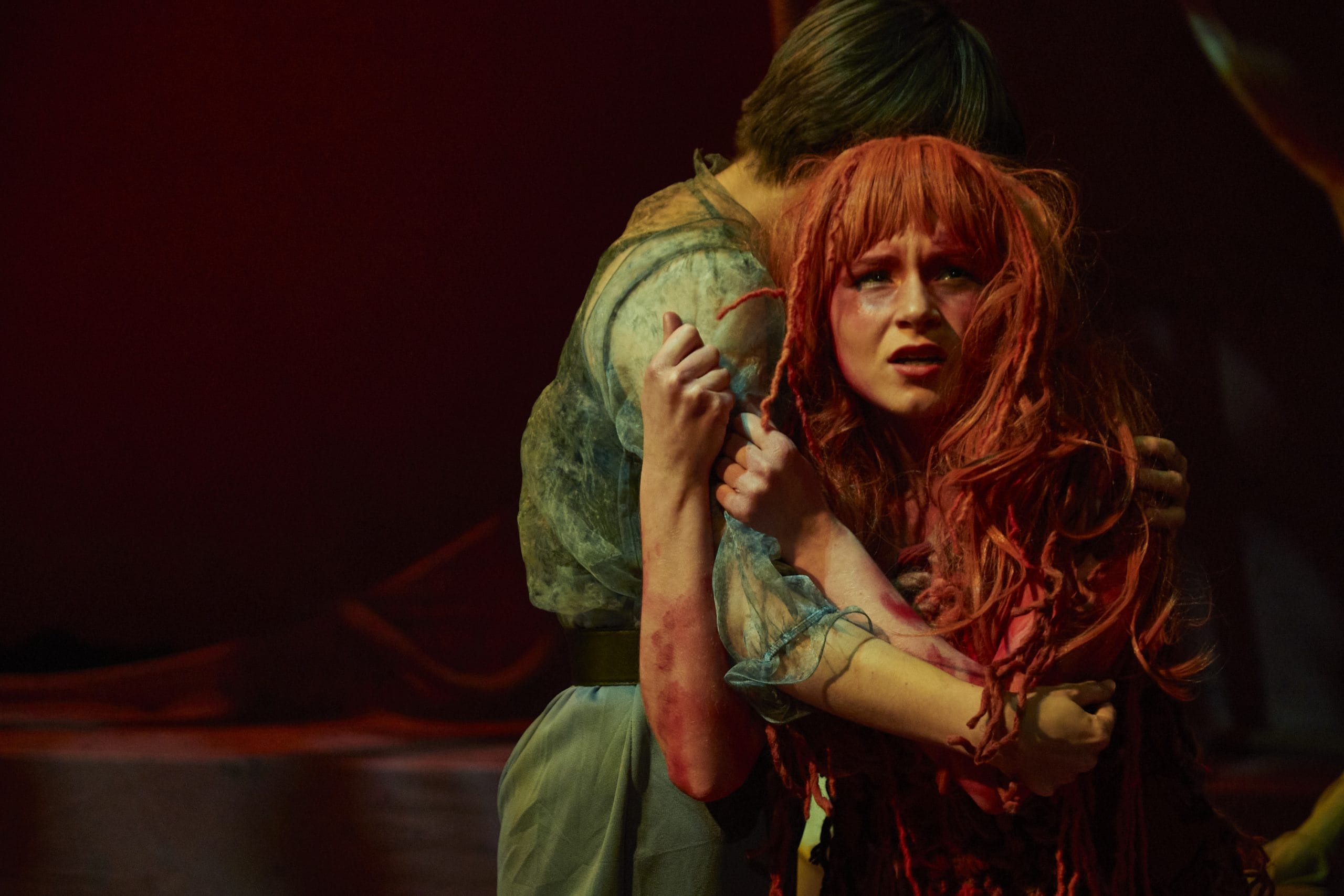
As one of Shakespeare’s most ubiquitous tragedies, audiences enter a production of Macbeth thinking they know what to expect. Flabbergast Theatre were unafraid to prove them wrong with a primal, movement-based adaptation of the play that fascinatingly centred the witches and the supernatural threads that run throughout.
Set in a vague never and nowhere (or always and everywhere?) the design of the show was sparse and cohesive, with every actor dressed identically in grey, and the stage set only with a large cloth covering the floor and large drums wrapped in the same fabric. The play began with an image of the witches leaning one over another, their faces and the distinctions between their bodies obscured by hair. With their arms poised outwards like the legs of a large insect, they displayed an unsettlingly inhuman figure that set the tone for the rest of the play.
Their influence over the plot and characters was evident throughout in the non-naturalistic style of the performance, more reliant on dance, music and soundscapes than staying true to Shakespeare’s text and – though this approach I’m sure would not appeal to everyone – this was to me the strongest element of the play. The bold disruption of so well-known a script offered a unique perspective on the play and its themes, creating a transportational experience that took the audience far beyond their own expectations and preconceptions, allowing them to experience it as something new – no mean feat for a show with 400 years of staging history behind it.
Taking clear inspiration from such practitioners as Artaud and Le Coq in the wordless and unintelligibly spoken scenes, the audience became invested in what they were seeing as opposed to just what they were hearing, or pleasantly unsettled when what they heard was not what they expected to. For instance, King Duncan was introduced by a song performed by the entire cast as a chorus, rather than in their usual roles. Moments like this, when the distinctions of character faded and the story was told as though by one cohesive unit exacerbated the evocatively primal energy that ran throughout the performance, creating a timeless, folkloric atmosphere. This communal, almost proto-theatrical style of ritualised performance dismantled the conventional divide of actor/audience, acknowledging the artifice of story-telling and inciting awareness of the play as one that has been performed countless times, rather than trying to invest the audience into it as though real or happening synchronously.
As stated, for me, these primal, non-naturalistic and metatheatrical elements were the play’s pinnacles. However, the attempt to still retain a more conventional spoken performance of certain scenes tore through the otherwise immersive atmosphere of ritualistic storytelling. Many of Macbeth’s longer speeches felt rather out of place in the production, as suddenly the actor broke fully from the communal performance that characterised most of the play to speak for extended periods in an entirely different style. These scenes, though technically the most respectful of the source, felt erroneous to this production, as though included only because audiences expected them. I think that the production would have benefitted from an entirely unwavering commitment to the physicality, music, and ambiguity that made it unique, and was adept enough at conveying the story to make superfluous as much straight speech as there was.
Overall, this production was a strongly creative and unconventional approach to Macbeth, but at times seemed to grow almost self-conscious of its strangeness and revert to classic Shakespeare in a way that disrupted the flow and left the audience uncertain of what exactly it was trying to do.
Flabbergast Theatre’s Macbeth is one of those rare productions that doesn’t just present Shakespeare, it engulfs you in an atmosphere so tactile, so sensorially charged, that you feel less like an audience member and more like a participant in some ancient rite. From the moment the medieval-beige world materialises onstage, the production’s visual language is arresting. Bells, gongs, and ritualistic chanting fold into one another, creating a soundscape that feels both sacred and unsettling. Even the smell, boxed wine mingling with clay, worked its way into the experience. This grounding the performance in something earthy and bodily. It’s a world you don’t just watch; you breathe it in.
What impressed me most was the company’s willingness to subvert the traditional Shakespearean mode. Their use of Artaudian techniques, particularly the Theatre of Cruelty, felt daring and unexpectedly harmonious with the text. As someone who admires Antonin Artaud’s work, I was surprised by how naturally his ideas fused with Shakespeare’s psychological brutality. Yet this boldness made me wish they had pushed even further. There was definitely room to lean fully into that stripped-back, raw physicality. At times, the conventional soliloquies felt like remnants from another production entirely, static moments interrupting an otherwise immersive, ritualistic flow. I found myself craving even less dialogue, not out of impatience, but because the physical storytelling was so much more compelling.
One moment, however, was nothing short of breathtaking: Macbeth’s silent scream upon becoming King. It echoed the iconic gesture from Brecht’s Mother courage yet stood firmly on its own. The stillness, the tension, the sheer emotional rupture contained in that soundless cry. This was the kind of theatrical moment that forces you to sit with it, to absorb its weight. It revealed more about Macbeth’s inner conflict than any monologue could have.
Perhaps this is why a later creative choice puzzled me. In Act Two, a full scene left almost entirely untouched, and the sudden return to conventional dialogue felt jarring. The production had already established such a potent physical vocabulary that this reversion disrupted the rhythm. It’s not that dialogue has no place, far from it. The witch sequences, for instance, were electrifying: the layered chanting, the shadow play, the animalistic energy. These moments proved that spoken text can thrive within this aesthetic when integrated with intention. But the inconsistency made the narrative harder to follow, especially for audience members unfamiliar with Macbeth. The abrupt shifts between immersive physicality and traditional Shakespearean delivery created a kind of a whiplash, and it was noticeable that some audience members didn’t return after the interval.
Still, when Flabbergast commits to its ritualistic, visceral style, the production is extraordinary. The supernatural world they conjure is unlike any Macbeth I’ve seen. Raw, primal, and genuinely haunting. If anything, the production’s weaknesses stem from hesitation rather than misjudgement. They had built a world bold enough to sustain even more radical choices, and I found myself wishing they had trusted that world completely.
Flabbergast’s Macbeth is not perfect, but it is undeniably powerful. It’s a production that lingers, on the skin, in the senses, and somewhere deeper, where ritual and storytelling meet. It left me exhilarated, intrigued, and eager to see how far this company might go if they fully surrender to the theatrical language they wield so beautifully.
Flabbergast’s production of Macbeth begins before the lights go down. As we enter the theatre and the school groups find their seats, the witches are already there. Already watching. Already working. Steady movements across the stage and quiet vocalisations, ease us into their world before we even read the programme. This production’s quiet genius doesn’t need to announce itself. It just pulls you in.
The sound design really caught my attention, as instruments are embedded into the set, including drums, a rack of small gongs (similar to a yunluo), a large gong, and large wooden sticks that thunder through Banquo’s murder and the military advance of Birnam Wood. Pitched plates are held individually across the stage immersing us further into their world, but making us follow the bouncing sound across the space. We are manipulated alongside Macbeth throughout, enthralled by mysticism and unease. The percussive rhythm heavily emphasises Shakespeare’s tone, Iambic pentameter makes up a lot of the play, and its heartbeat-like rhythm is honoured, mimicked and supported by the instrumental ensemble. Syllables and drumbeats work in quiet conversation, keeping Shakespeare’s voice subtly and fully present like the rest of the production, strongly conveying the essence of Macbeth.
A minimal colour range unites Flabbergast’s world, including the three witches, painting them as presently as the other characters. The witches are never really offstage. Even when an actor is needed as Lady Macbeth the others linger, framing her centrally as if she is just as powerful and manipulative. They present her, they second her, they claim her. Whatever the power dynamic, the female divine consistently shines at the core of the play. Their voices, as three witches chanting together, are bound into a united force while each individual tone is distinct. Their power is in unity, and their individual selves celebrated.
At points in the play where chaos breaks free, actors move in all directions across the stage making different noises, banging different drums. It is all a blur, but all so controlled. Banquo’s ghost sequence for example is a swirling dance of flipped tables and suggestion. Part of the play’s choreography includes light projected upward from the centre front of the stage. It creates ominous shadows for those at the centre and smaller ones for those behind; Macbeth is enormous and powerful, and others cower behind him in all his terror and darkness.
The Porter’s comedic relief has him running through the audience, party hats sailing into the crowd, earning lots of chatter from the school group and many excited three-horned party hat heads. Shakespeare’s name is repeated directly, as Flabbergast acknowledge the artifice of the work and the weight it carries. Respect for the play is given and tested, making me reflect on how I studied Macbeth in school and how it would have given me space for exploring the play further at the time acknowledging its past versions, current production and future plays to come.
As Macbeth draws to a close, harmonious and dissonant voices float around the theatre. A peaceful, grieving and satisfactory tone leaves us in quiet pause before the applause breaks out. Shakespeare’s writing feels alive and truthfully told, at this intriguing production of this mystical tragedy, the famous Scottish play.