








As part of our Young Critics Collective programme, our reviewers give their thoughts on Victoria Firth and Company's BATTY!
Through storytelling, gossip, humour and moments of exquisite tenderness, BATTY! explores the menopause and the changing experience of being a middle-aged woman.
Young Critics are an imaginative collective of students who value collaboration and innovation. Together, they review and help shape future theatre programming.
BATTY! reviews
BATTY!, written by and starring Victoria Firth, is a rich, spellbinding exploration of womanhood, ageing, and identity that invites its audience into a world where the boundaries between woman and witch become increasingly blurred. Equal parts intimate and enchanting, it is a production packed with heart, humour and striking theatrical imagery.
The first thing that captivates is the set. Batty’s cluttered cottage feels completely lived in, with blankets draped across furniture, buckets gathered around the sink, and every corner filled with personality. It possesses a wonderfully natural energy that grounds the performance whilst also carrying the unmistakable atmosphere of a witch’s dwelling hidden deep within the woods. This duality comes alive most powerfully during blackouts, when candles become the primary source of light. In these moments, the performers appear almost otherworldly as they move through the space, transforming the stage into something magical and ethereal. The design continually rewards the audience’s attention, particularly in the final moments when a single beam of light shines through the window with breathtaking delicacy. Equally beautiful is the way light filters through the clock, creating a perfect canvas for bat shadow puppetry. These details feel like expressions of the care and affection poured into the production. My only reservation came with some uses of coloured lighting. While emotionally justified and visually attractive, the larger washes extending beyond the confines of the set occasionally disrupted the intimacy of the world, momentarily drawing attention away from the carefully crafted illusion.
At the heart of BATTY! is a fascinating exploration of binaries. Early on, the production introduces the idea that people exist on a continuum rather than at one fixed point. Here, that continuum stretches between woman and witch, examining how society often labels women as something “other” once they move beyond conventional expectations of femininity. It is a compelling framework through which to explore menopause, ageing and selfhood. However, one creative choice jarred with this otherwise thoughtful examination. The inclusion of a Harry Potter reference felt strangely at odds with the themes being explored. Like the use of coloured lighting, in a show so invested in challenging binaries, questioning accepted narratives and embracing alternative perspectives, the reference pulled me out of the world and felt disconnected from the broader conversations the production appears eager to have.
Audience engagement grew steadily throughout the performance. Whilst it took some time for people to settle into the show’s rhythm, laughter became increasingly frequent and the audience were clearly invested by the end. This was especially evident during the post-show discussion, where several audience members reflected on specific sequences in impressive depth. One particularly memorable example was the water bottle sequence, which deliberately disrupts the natural world of the play to introduce questions surrounding artificiality and environmental damage. Discussions touched on everything from microplastics to the pressures placed on women to embrace synthetic ideals of beauty and behaviour. The fact that this scene generated such layered interpretations speaks volumes about the production’s ability to provoke thought without prescribing a single meaning.
The performances from Victoria Firth and Kathryn Hanke are equally captivating. Through physical theatre, rapid-fire dialogue and carefully crafted movement, they create a deeply connected world where every gesture feels purposeful. Hanke’s transformation into a tree for Batty to lean against is a particularly beautiful example of how physicality generates meaning beyond words. The standout moment arrives during Batty’s monologue as she stands by the door letting the dog out. The combination of lighting, sound and Firth’s empowered presence creates a genuinely unforgettable theatrical image. There are occasional moments where the storytelling feels more conventional, particularly in sequences depicting daily routines through repeated mimed actions and quick-fire narration. While effective, they lack some of the originality found elsewhere in the production.
Overall, BATTY! is a warm, thoughtful and visually stunning piece of theatre. Its blend of folklore, feminism and physical storytelling creates an experience that is both engaging and moving. While there are moments where it feels as though the production could dig even deeper into its fascinating connections between witchcraft, womanhood and identity, its foundations are exceptionally strong. What remains is a charming, intelligent and often magical evening of theatre that lingers long after the candles have gone out.
In the world of Batty! there is little distinction between what makes a witch and what makes a woman. Conceived by Victoria Firth, the production celebrates all that is natural: our natural environment, natural desires, natural bodies. In the final show of their tour, the company of Batty! provided a riotous celebration of their feminine eccentricity, from magic to menopause to madness – or, as Firth insists, their ‘wildness’.
Emma Williams’ design of a provincial cottage-cum-artist’s retreat is a pocket of warmth nestled within a dark and empty stage. There is a peculiar comfort in the skewed wooden windows and countertops, each as rugged and rustic as if carved straight from a tree. Strikingly, a clock framed at centre stage (appropriately hand-less) dispels all temporality. As each of Batty!’s sixty-five minutes transpired without my notice, I was confronted by my mounting desire for such a life: one free from the paraphernalia of modernity.
If Williams’ setting is the lungs of the production, Victoria Firth is the breath which brings Batty! to life. From the moment we step into the theatre we are beckoned by our observing protagonist Batty, whose easy Yorkshire charm and earthy-hued dungarees provide familial comfort. While Batty! may posit Firth’s reflection of ageing womanhood, the curiosity of youth seeps from her every howl, gasp and gesture.
Firth’s authorship is as resonant as her physical performance. Batty! shies from conventional structure, comprising a collection of non-linear musings each connected by emotional threads of shamelessness and vulnerability. Firth effuses confidence and authenticity with each pelvic thrust and ruffle of body hair; I particularly delighted at the audience’s ripple of amusement as Firth performed a sequence of provocative broom-ography. Through her unabashed address of the taboo, Firth challenges us to take pleasure in the absurdity of our own naturalness.
The second of the two performers is Kathryn Hanke, whose energetic performance as Wildthing complements Batty’s introspection. I enjoyed the pair’s display of feminine domesticity as they grappled with a shared blanket in a quasi-marital bed. Yet Wildthing straddles shifting identities; this ambiguity is at times confusing. Is she a sister? A witch’s familiar? Or an agent to prompt the ruminations of her companion?
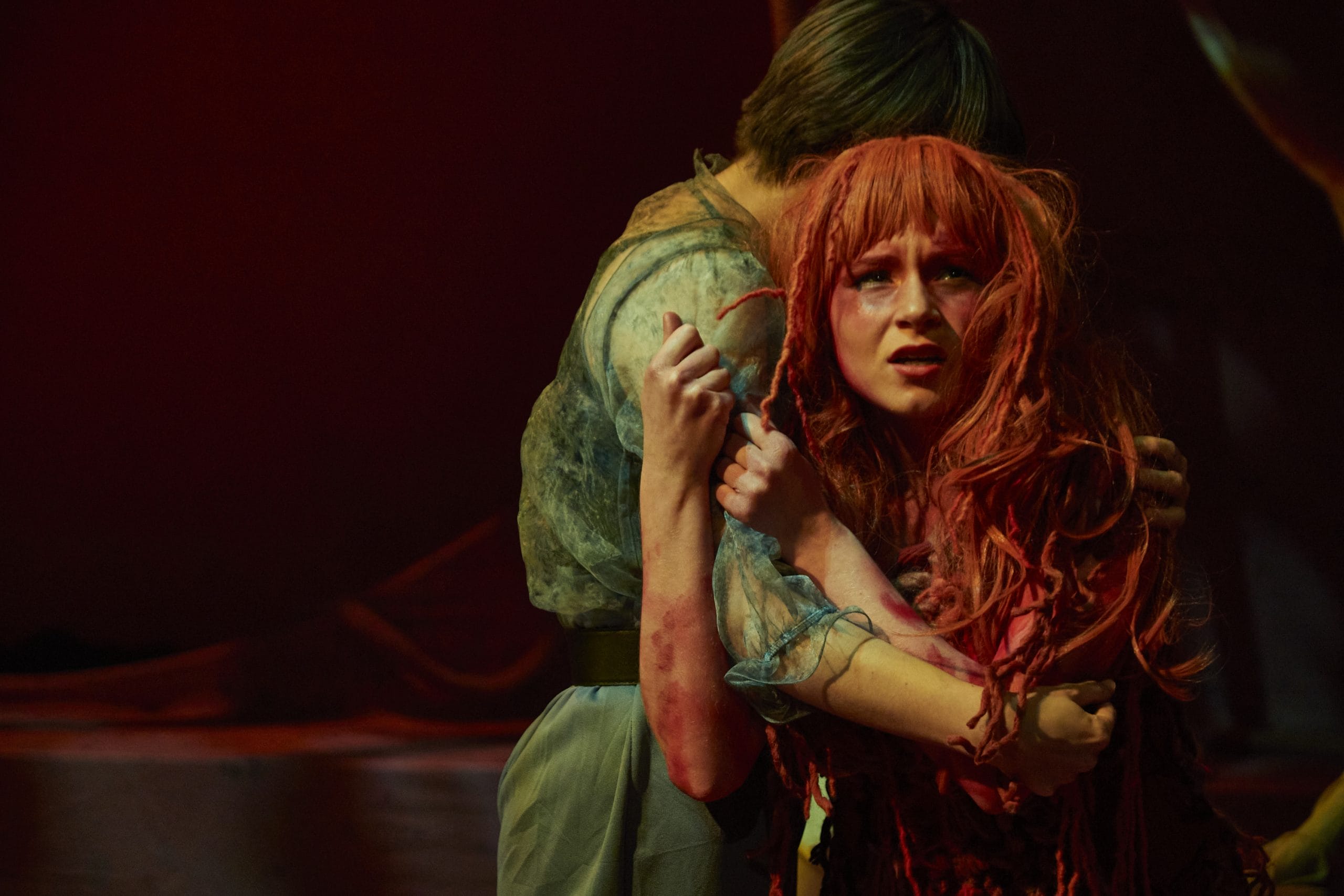
While the pair’s relationship is uncertain, their messaging is clear. These women are not infallibly whimsical: the audience is confronted with ruminations on compulsive eating, sexual shame, and a deep longing for something ‘more’ than what modern life has to offer. In a display which toes the line between theatre and performance art, Batty attempts to dispose of a plastic bottle – a dissonant reminder of modernity in the antiquated backdrop – by eating it. As Firth sequentially cut, crushed and chewed, a taut hush was palpable amidst even a modest audience.
Batty! is a play which is built on the compassion and care of its creators. Victoria Firth and Kathryn Hanke create a sanctuary for the brash, the gross and the unconventional: the sweatiest corners of womanhood. Yet the pair leave us with the idea that no woman’s wildness should be confined, and no witch should be forced into seclusion. In the play’s closing moments, Batty takes leave of her humble home: she swings open the crooked window and climbs into the moon’s dappled light. As an audience member, I am compelled to wish her well; as a woman, I am compelled to follow.
On the night before Halloween, Batty! cast spells over Nottingham. Performer, writer and director, Victoria Firth, brought a playful exploration of witches and women to her middle-aged character. She presented Batty with a weird and wonderful grace. From chanting songs to menopause, her words filled the theatre with spirit and wild abandon.
While the house lights were still up, Batty looks out encouragingly, smiling at us. Personal and homely, a room centre stage has space around it, presenting the cosy interior with the darker outside. This is a home for a witch who is sure of herself warm by the fire as in the moonlit woods outside, though she may not know it yet.
Firth’s Batty is a middle-aged woman considering the identities of woman and witch. In doing so, she enthusiastically examines where she fits into everyday terms. The mind, with its mindfulness, mind-your-manners and mind-over-matter, don’t suit her so well, so she turns to the body: embodiment, bodies of earth and water, swimming naked. Her thinking aloud presents like chanting, following every thread of thought to its end as if specifying desire in a spell. Even more so as Batty’s companion Wildthing, played by Kathryn Hanke, sings over Batty in mockery. Drumming fingers, stamping feet, and the rhythm and lilt of their voices, pull us deeper into a witches’ circle.
Alongside making music with their bodies, the pair follow an imagined bat across the room, gaze into a mirror and cover the entire stage in tangible storytelling. The fluidity of their movement and commitment to physicality, truly embodies the passion and innate knowledge of a witch. This is an enthusiasm to know themselves fully, physically, emotionally, erotically, and spiritually.
Between scenes, the lights go down leaving a candle and fireplace to give warmth to the darkness. The theatre’s rigging above throws hazy shadows across the ceiling. We are not watching Batty! being performed on stage but are brought into the magic entirely. The silhouettes of Batty and Wildthing stand back-to-back in symmetry, scooping air over their faces in unified ritual. Later, they toss shoes from a drying line into water, another ritual that emphasises the natural elements on stage, then peg them back on the line to dry ready for this ritual to be performed again. Then a red scarf flies in the wind, before becoming a ripple of water, then a majestic gown. A bucket becomes a chair and a book a laptop. Transformation is a magic of witches and women, a practice of the practical and magical.
Batty consistently connected with the audience, humorously relatable with her menopausal waves of hot and cold at night and her refusal of shaving body hair to take a societal stand. Her firm stance against madness invites us all to lean into our wilderness.
I expected Batty’s appearance to grow wilder towards the haggard witch of fairytales, as her hair was brushed backwards causing it to blow like a tree in the wind. It grew neater instead, showing that witches exist in all forms but often in the everyday. As time goes on our wisdom deepens; we can become childlike again, realising the flaccidity of societal constructs. Perhaps the most intelligent thing we can do is to fully commit to impulse and abandon together.
At the close, Batty climbs out the window into the night, and we howl together as the cast bow. This is hardly an ending though. The moon-like clock onstage has no hands; this is a story of the everyday and the magical, it continues in every form, mundane and unexpected. The echoes of ‘witch’ playing over the theatre speakers will follow you home until you too perform your nightly ritual. In Lady Macbeth, your mother and yourself, the wilderness calls…
From the moment of entering the Lakeside Arts auditorium, the audience of Batty! were invited into a friendly intimacy with writer and performer Victoria Firth, who sat on a soft armchair in a delightfully homely witch’s grotto. Designed by Emma Williams, the simple wooden cottage room furnished with a small bed, armchair, and kitchen area that comprised the set created an immediate sense of closeness with the performance, as though we were visiting Batty deep within herself.
This atmosphere of openness and vulnerability continued even beyond the performance’s end, when Firth and fellow performer Kathryn Hanke sat down for a casual discussion about the show, allowing those few audience members that stayed to engage directly with the performance and what it meant to them. Exacerbating the comfort and closeness that inspired such open discussion open was the warm, gentle lighting within the set; an artificial fireplace, fairy lights strung over it, and candles placed around the room. All this simple homeliness worked to immerse the audience and provide a deep tone of honesty, of a comfortable space in which anything could be said and heard without fear.
And much was said. Firth and Hanke, as Batty and Wildthing, took the viewers on a whirl of a journey through the psyche of a middle-aged woman struggling to determine what it means to be so in a society that prizes feminine youth and conventional beauty over anything else. While undeniably important and often eliciting laughter at their witty relatability, I couldn’t help but find Batty’s musings on witchcraft and womanhood somewhat surface level at times, lacking the radical edge that a show like this needs to stand out from wider conversations on the same themes.
One moment stood out to me as having a hope of performing this leap beyond, as we watched Batty masturbate with a broom in a celebration of female empowerment and sexual liberation, reclaiming an object of both restrictive domesticity and villainised witchiness for her own pleasure. But this transcendent message was flattened when Wildthing interrupted to comment on the embarrassment of it, the whole thing played for laughs instead of with the sustained seriousness that could have made it something more than a reiteration of female shame.
That being said, another of the major conversations throughout the play was dealt with far more earnestly, to the point of being perfectly hard to watch at its peak. The set, props, and costumes having primarily a very natural look to them, as a way to emphasise the connection between women and the natural world that the show promoted, the sudden introduction of a plastic bottle became as incongruous and disarming to the audience as it was to Batty and Wildthing. Firth stated in the post-show discussion that the performance was rooted in natural cycles, like aging and menstruation, and that the plastic bottle meant to represent a cycle-less thing, something outside of the natural order that would simply last in unwavering stasis.
In an act that to me portrayed the impossible responsibility to rectify the mistakes of our species that often seems to fall on women, Batty offered (and tried) to eat the plastic bottle. In a gruesome scene of her chewing fruitlessly on this plastic, Batty! so poignantly depicted the helplessness of being a person who cares about the world in an age of rampant climate destruction that the usually chuckling audience were utterly silenced. We were made to sit, the words that Batty had earlier sung about the nature of life and death as a cycle of consumption echoing in our ears, as she tried to consume this inedible object.
Though the middle-aged female experience is most definitely one that deserves far more exploration both on the stage and beyond, I couldn’t help but find that Batty!, for all its promised wildness, didn’t quite fly free of a relatively cliché and simple depiction of aging as a woman, though it would make a great introduction to these topics.
Victoria Firth and Company’s tremendous Batty! is a hilarious, relatable and oddly profound performance that explores all of womanhood and witchiness. Through monologues to the audience, friendly banter and beautiful music it really feels as if you are on facetime to an old friend while Batty explores her wilder side. This production really is for the everywoman, all girls from teens to middle aged to senior feel a sense of being understood and seen.
As you walk in, our titular character played by Victoria Firth herself sits on a comfy chair, sipping tea, crafting a peg doll and smiling to the audience. The openness in this first scene, before we even begin, sets an atmosphere of coziness and familiarity. An all-natural set in cyan with uneven wooden planks and crude tin buckets frame a miss-match quilted bed.
Batty asks, looking right at you, “what is a witch?” This poetic monologue that begins our journey looks at the classic characteristics of a witch, old and alone and ugly- all the things we associate with aging. As a woman, you are faced with the reality that we are obsessed with youth, trying to constantly be preened and pretty in an ever-changing world. As we watch Batty, and she watches us, Wildthing (played by Kathryn Hank) emerges all limbs, an animalistic entity that comes from behind the lone bed. She is carefree and questioning, challenging Batty as she complains of her growing moles as she grows older.
The more time Batty spends with Wildthing, the more charismatic she becomes. Her growing wildness illustrates just how much we change over time, that life a series of cycles we move through. Repeatedly, a mirrored dance of sweeping stretches accompanied by calming music occurs at the beginning of each new day. Yet the contents are drastically different, there’s playful drunkenness full of captivating movement backdropped with a fiery red cloth that reflects Batty’s passionate personality. Another day, our characters clean the house, talking of things like body hair and romance.
The whole production encapsulates the realities of girlhood, queerness and what it means to embrace yourself. The rollercoaster of emotions reminded me of going through your period; there were highs of singing your favourite, lows of anger, and moments of laughter.
But one question remains throughout, what is a witch? That is for us to answer. Firth shared how the performance is for us to interpret, the answer for us to decide. We can take away from this ambiguous, beautiful performance what we need to find our own wilder side.