




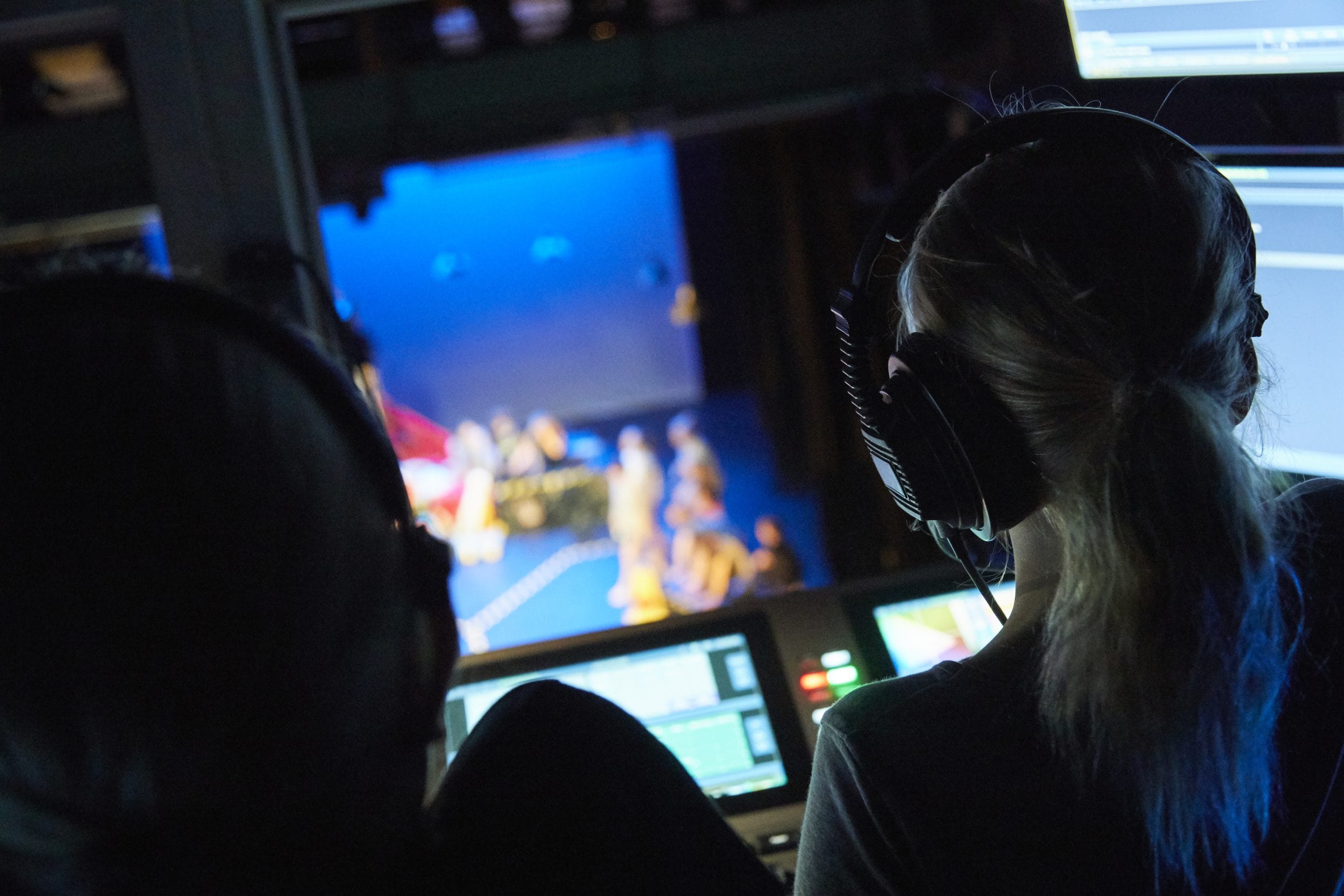

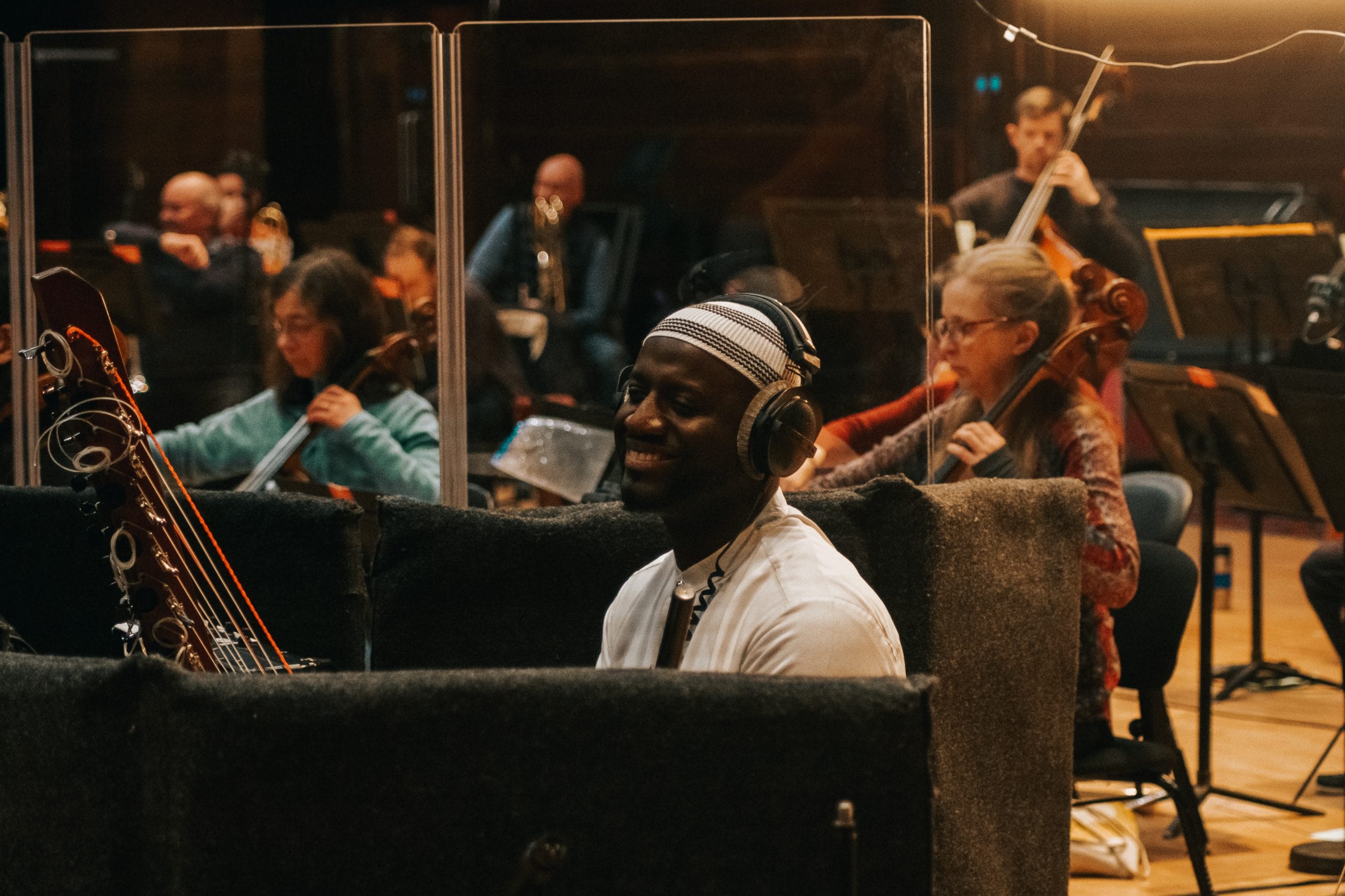



As part of our Young Critics Collective programme, Arwyn Clayton and Kirsty Tidmus reviewed Bach Reimagined.
James Wilton Dance’s trademark athletic, flowing physicality collided with the electrifying heavy metal cello of Canadian cellist Raphael Weinroth-Browne to create a spectacle of beauty and ferocity, reimagining the genius of Johann Sebastian Bach, from his music as divine worship to the scientific breakthroughs of his contemporary, Sir Isaac Newton.
Young Critics are an imaginative collective of students that value collaboration and innovation. Together, they review and help shape future theatre programming.
Reviews
The stage is empty but for a small raised platform upon which waits a prone cello and a selection of pedals. The audience, while far from raucous, are anticipatory, this Chekhov’s cello promising baroque beauty. And from the first sonorous notes that Raphael Weinroth Browne sawed from it, their waiting was appeased. Making use of the pedals at his feet, Browne played and looped and layered the music live, letting it build and develop with the dance which it accompanied. So dreamily enchanting was the music that at times, in spite of the talent and energy of the dancers, it was hard not to let your eyes glue to the musician, or fall closed in order to let yourself be completely swept up by the sound. Some of the most moving moments of the show occurred when the dancers themselves acknowledged the cellist, as when they sat, still and connected and watching the notes take shape.
But, entertaining as the music was alone, Bach Reimagined is primarily a dance piece, choreographed and performed by James Wilton and Sarah Jane Taylor. In an age of high-budget stage spectacle, it is refreshing – not to mention impressive – to see the work of just three people fill an entire stage, without once losing hold of the audience’s attention. Though this show had a less clear plot to follow than other pieces of dance theatre that I have seen, the themes of artistic struggle, inspiration, and the cost of creation were strongly woven in. One highly memorable action was that of Taylor, silhouetted from behind a kabuki drop, mimicking the movement of cello playing against her own torso, as though sawing herself in half with the shadow-bow. The anonymity and implied violence of this moment beautifully depicted the timeless metaphor of self-flagellation for the sake of creative output. Another stunning scene occurred towards the end of the show, when Wilton danced with first one and then two pois circling his head and evading his grasp in an ethereal evocation of the tantalising incorporeality of ideas, the near impossibility of stilling and solidifying them into something to be shared.
Intensifying that which the music and dance conveyed were the various lighting states, designed by James Wilton assisted by Seth Rook Williams. In particular the recurring state of rainbow lighting, which first appeared behind the aforementioned gauze and produced three shadows of different colours replicating Taylor’s dance. Combined with the music and the movement, these stunningly hued, faceless silhouettes created an irrepressible atmosphere that the audience couldn’t look away from. Yet simpler lighting was equally effective in anonymising the performers, with much of the show being backlit, only the face of Browne in his own small, moon-like spotlight unobscured by darkness. This drew the audience to focus on the bodies of the performers, the way they moved and particularly the way they interacted, although perhaps sacrificing some potential clarity of plot and emotion that more visible facial expressions would have provided.
On and off throughout the show a recurring thinly beamed spotlight cut through the centre of the stage, and the dancer’s hands clasping within this beam while the rest of their bodies were in comparative dimness perfectly expressed the show’s apparent priority of the body in motion as storyteller. While this may have limited the audience’s understanding of the piece, it was nevertheless an engaging watch, with the grace and skill of the dancers and cellist hooking our attention even without a fully tangible narrative.
BACH Reimagined presents an intriguing blend of dance and music to produce a visually stunning performance exploring what it means to be an artist and create art, as well as the enduring nature of the work of Johann Sebastian Bach. This intent behind the performance is outlined by an accompanying programme, so whilst it is not particularly overt onstage, it is nonetheless a captivating and accomplished show. As perhaps is to be expected, the show attracted a primarily older demographic, those who may be familiar with the music of the famous composer, however, there was a pleasing amount of young people also present in the audience.
Fundamental to this performance was the live celloist, Raphael Weinroth-Browne, as he provided the musical backdrop to the dance onstage. The quality of his musicianship showcased a prodigious skill, the lack of any obvious sheet music making his performance even more impressive. Intriguingly, the performance utilised loop pedals to create the ambient sound of multiple instruments without the need for more musicians. By playing each melody separately, to loop and then layer the tracks, Weinroth-Browne was able to create a complete piece of music. This looping technique also allowed aspects of the dance to compliment the musical layers individually – a staccato track inspiring short, quick movements for example, or a slower melody encouraging more flowing, controlled movements. The way the music and movement interacted seemed to illustrate the production’s focus of what it is like to be an artist and to create art.
The staging of this piece was intentionally minimal, its simplicity allowing the dynamic movements of the two dancers to take precedence. The dance was very dynamic, often fast paced to mirror the accompanying music, although there were also contrasting moments of stillness, which allowed both audience and performers to refocus before continuing. What was evident, was a sense of trust between the two dancers, as they frequently lifted, balanced or caught each other throughout the performance. It demonstrated an impressive level of skill and expertise that was fascinating to watch.
One particular moment that stood out was the use of a kabuki drop. This involved a white, semi-transparent curtain dropped from above to cover the stage, before it fell away to fully reveal the performer. Unfortunately, when the curtain fell during this performance it was twisted, so the initial effect was somewhat lost. However, it was fixed seamlessly and could easily have been mistaken for part of the performance. Prior to it being dropped, light and shadow were utilised to project a silhouette of one of the performers onto the curtain. In a moment of beautiful mimicry, the performer moved a cello bow back and forth across her abdomen, whilst elevating the other arm, thus transforming herself, and her silhouette, into the cello being played.
Something that cannot go unmentioned, is how lighting design was used to direct audience attention or was incorporated into the narrative of the dance. For example, a thin strip of light projected centrally down the stage became the dividing line between the two performers. Positioned on either side, they acted as reflections, precisely mirroring each other’s movements, this conveying a cohesiveness between them. Their closeness was also suggested by how their hands, or a small part of them, never left this beam of light.
Occasionally, while the lights would direct audience attention to a particular part of the empty stage or towards the dancers sat motionless, there would be a pause that could feel somewhat overlong. However, in these moments it was evident that the cello was being reset or reconfigured. And, once the performance resumed, audiences were never disappointed as to the grace and skill of both dancers and musician.