





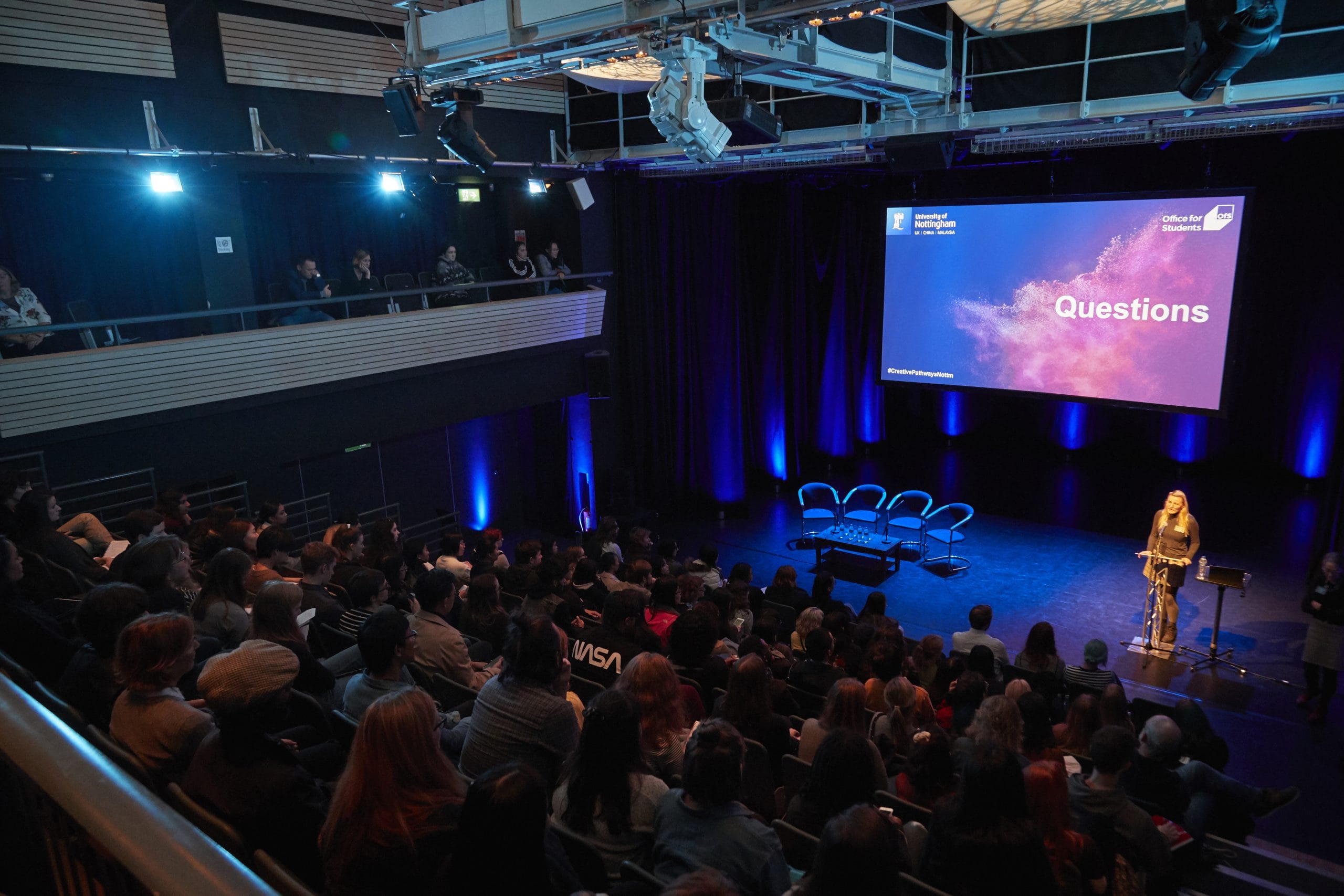




On June 24, at Lakeside Arts, Artists Penny McCarthy and George Shaw (Turner prize nominee 2011) reunited to examine some of the themes threaded throughout Drawn Through Time. Joined by an audience in the Djanogly Gallery, they guided us through the vast conceptual links behind this exhibition. This article reflects on the relationships between art and history, memory and myth and how time travel might really be possible…
“Art is the power that causes the night to open”. – George Shaw quoting Maurice Blanchot, The Gaze of Orpheus.
At the heart of this exhibition sits Titian’s The Submersion of Pharaoh’s Army in the Red Sea (c.1549), a colossal work assembled from 12 printed woodblocks. Inherent in the creation of the print was the destruction of the original drawing, which was sacrificed as it was carved through onto the wooden blocks. This absence is what initially drew McCarthy to the piece. She saw it as something that has been lost to time yet remains wholly relevant to the contemporary world. So, she undertook the monumental task of reconstructing it – an act of imagination and interpretation.
As McCarthy explained, the woodblocks themselves have changed over time. They have warped into different shapes and sizes, no longer fitting neatly together. Paper destroyed and information lost, little pools of empty space emerged. Rather than disguise them, “fake it”, she chose to leave them visible. Looking at her recreation, you can see not only Titian’s hand, but her own reaching out to him across time.
George Shaw described the process as being “like someone trying to remember their life”. Memory rarely arrives at us complete; we reconstruct only fragments of the past, piecing them together. We fill these gaps with imagination and fantasy, but often the lines between recollection and invention blur.
In the exhibition, McCarthy deconstructs and isolates the broader themes of Titian’s work. Her piece, cleverly titled Ocular Event, depicts an ominous fog rising above the sea. The dual meaning of an ‘ocular event’ invites us to question how much of our perception reflects the true nature of the external world, how it can become distorted, and how often it is unclear. Following this thread, many of the curated works suggest that history is never simply recovered. It, too, is interpreted; there are always voices, people, and narratives that are erased or forgotten. Drawn Through Time encourages us to pick apart the stories we inherit, and the assumptions woven into them.
After spending months tracing the lines of Titian’s woodcuts, McCarthy felt pulled towards the protagonist – the Red Sea. She compared the process to scrying, the ancient divination practice of gazing upon a reflective surface to uncover hidden knowledge. Staring into the body of water, she felt as though she was trying to “conjure something up”. The resulting series of drawings, The Last Sea I, II and III, emerged as “spontaneous” abstraction; free associations.
McCarthy’s inspiration from art historical works is echoed in George Shaw’s paintings. Recalling his time as an artist-in-residence at the National Gallery, Shaw frequently came across the works of Titian and Pollaiuolo, who drew inspiration from classical mythology. He often saw the themes reflected in his younger years, repeating across time. Speaking on Ovid’s Metamorphoses, he described it as “quite a basic text about sexuality, change, adolescence, cavorting about”.
Shaw’s work is centred around the council estate in Coventry, where he grew up, and the surrounding forest. Traditionally, in art history, woodlands are seen as mythical spaces, where the ‘unseen’ takes place. Shaw notes how they remain sites of exploration and experimentation, excluding authority figures: “The priest, the teacher, the parents”. They form spaces for “all the things that wouldn’t happen at home”, and I will leave it to you to imagine some of the examples he provided… Shaw pointed towards the idea that these myths remain compelling because they are distinctly human. They represent our desires and impulses – reflecting our own nature.
McCarthy: “I’ve increasingly become interested in the marginalia around a work… I think that’s an interesting place to position yourself – the edge, I like the mess of it.”
Throughout the discussion, both McCarthy and Shaw spoke of art as a living thing. McCarthy revisited times when she viewed artworks in galleries without the gilt frames. Underdressed, they suddenly seemed frail, no longer feeling like a distant ‘masterwork’. The margins of a painting often held “tentative marks” that had been removed from the final piece. She observed that these edges around the work allow you to “see that you are there with the person”.
In her recreation of Titian’s original drawing, Pentimento, McCarthy’s presence is felt throughout. She deliberately includes the marginalia around the work, scattered with handwritten notes. Later, Shaw referenced David Hockney’s observation that in the time it takes to construct a painting or drawing, within that piece are “a million thoughts a day, that you are passing through”. McCarthy gifts us these thoughts, suspended, there for us to dip into. Time, here, is not linear; the thoughts unfold to us nonconsecutively.
Figures and people are notably absent from many of the pieces in the exhibition, giving it an eerie, post-apocalyptic atmosphere. Yet, by placing the works behind glass, you start to notice your own reflection staring back at you. Standing in the gallery, deeply submerged in the works, you enter an imagined elsewhere. As Shaw noted, this is the potential of art: “It allows you to part the veil – exist in another world in another time, in another dimension”.
At the end of the talk, McCarthy and Shaw returned to the importance of engaging with something singular for a prolonged period. In an age of shortened attention spans and information overload, Drawn Through Time reminds us that it’s okay to slow down. As McCarthy traces Titian’s lines, or Shaw returns again and again to the woods of his childhood, they remind us of the hidden meanings waiting to be revealed upon a second glance.
Perhaps this is the closest we come to time travel; perhaps it is not confined to the realm of science fiction but is a possibility that we all carry with us – the possibility of moving through a picture.
Images from the talk


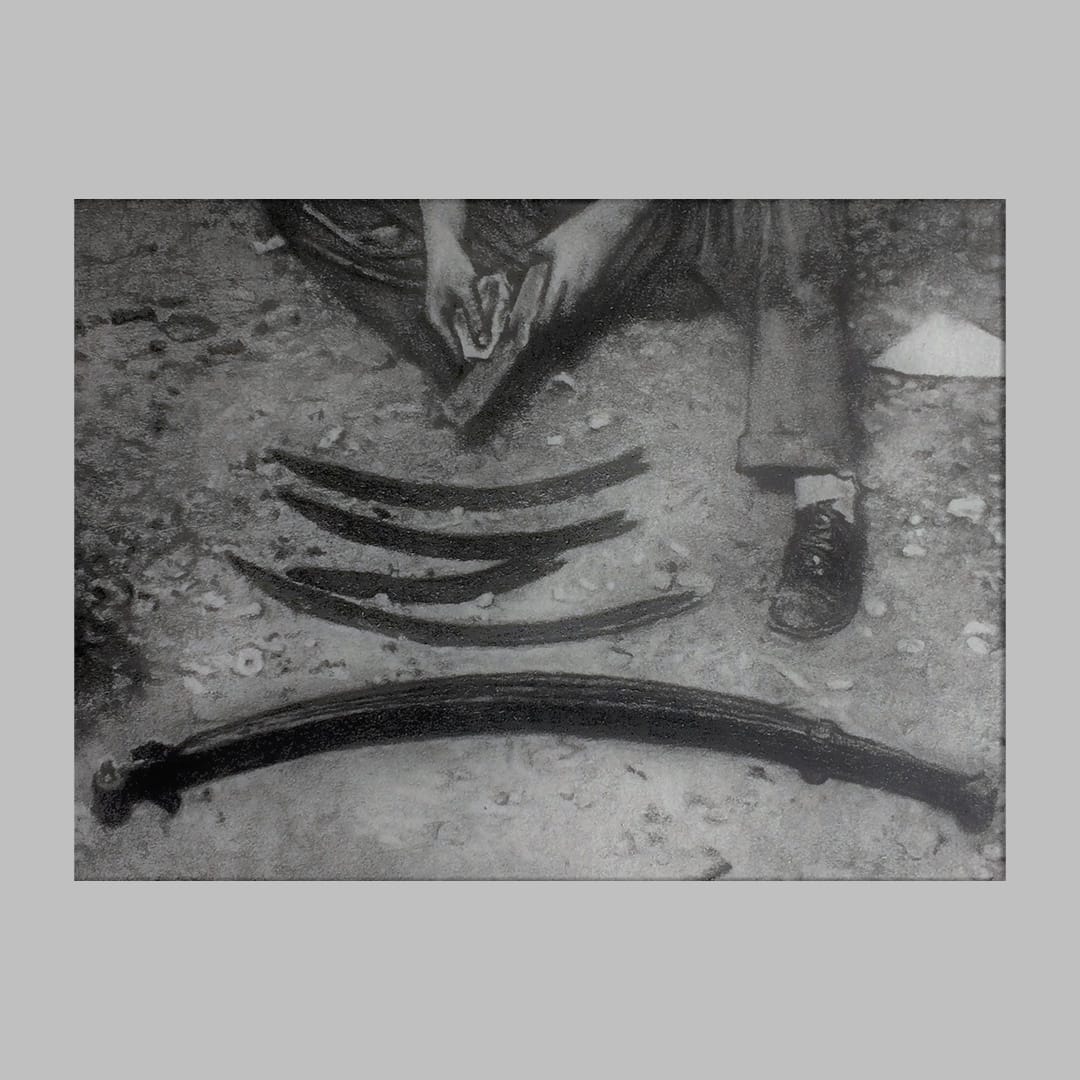

Drawn Through Time
Penny McCarthy, Titian, and Other Time Travellers
Free exhibition | Saturday 9 May – Sunday 26 July | Djanogly Gallery
Find out more